


Damp and mould are common problems in student accommodation, with around 42% of students experiencing issues with mould or mildew. These problems are especially noticeable in the colder months when there’s laundry to dry (and money to be saved on heating bills!) – but they can become a thing of the past if certain steps are taken when drying laundry. As experts with over 35 years experience in air treatment, we know a thing or two about creating a healthy indoor environment free from mould and damp. It starts with keeping the relative humidity (RH) below 68%, a precise figure which may not feel all that high – and can easily be left unchecked in shared housing – but it’s the point at which mould starts to grow.
So in this guide you’ll find out how to dry clothes in a student room, with some top tips on how to prevent damp when drying clothes indoors, and stop mould appearing.
Many of these tips are useful for any single room, whether you’re a young professional in a houseshare or have a dedicated utility space.
Why Drying Clothes Indoors Can Be Problematic
When drying laundry inside the home, damp and condensation often forms due to the excess moisture being released into the air. This excess moisture then creates the ideal conditions for mould and damp to thrive, both of which can cause health problems like respiratory conditions, allergies and asthma. Unfortunately, these can also be compounded with fresher’s flu and winter colds.
If laundry is dried in a colder room – which student rooms often can be, especially if your housemates are trying to save money on bills – it’ll not only increase the relative humidity, raising the likelihood of mould, but will take your clothes much longer to dry. The reason for this is that the colder the temperature is, the higher the relative humidity (and vice versa), which means your clothes are drying in a wetter space – the sort of environment in which mould thrives. We always recommend aiming for a target RH of 55%.
By the end of autumn after multiple loads of laundry, a damp smell may linger with much more force. This is very common in student accommodation but indicates what could become a bigger problem. Multiple loads of laundry, hanging and improper drying will cause them to smell damp and require rewashing, which will then lead to even more moisture being released into the air when drying, compounding the problem.

How to Prevent Damp when Drying Clothes Indoors
Using a tumble dryer – whether in your accommodation or launderette – can be expensive: it costs around £3-6 per load at a launderette, depending on where you are in the UK. Which, for better or worse, you may decide is better spent on a coffee or socialising, given the average student’s limited income.
If you end up drying your clothes on an indoor airer, it’s easy to end up with problems as a result of high humidity, but these issues are equally easy to avoid if you follow the right steps.
Here are our top tips if you don’t have access to a tumble dryer:
Run a Second Spin Cycle
The less water in your clothes, the better. Run a second spin cycle on your washing machine to wring out as much as possible before hanging on an airer.
Empty as soon as the cycle has finished. This avoids damp smells clinging to leftover laundry and to the machine’s drum. Plus, this clears the way for your other housemates to get their washing done too!
Space Your Laundry Out on an Airer
No, we’re not talking about radiators – an airer allows air to circulate much more freely around the laundry.
If your clothes won’t all fit on the airer, put some on hangers and make sure there’s no overlapping. This will help air circulate around all your clothes, speeding up the drying time and reducing the risk of a prolonged damp environment that would encourage damp and mould growth.
Choose the Right Spot – and Contain It
Dry clothes in one area – ideally the warmest, best ventilated room – with the door closed to prevent moisture spreading throughout the accommodation.
For many students, it’s as simple as using the central living space, if possible. Sometimes only bedrooms are available in busy homes, so keep your doors and windows closed and dehumidifier positioned close to target the clothes airer and circulate dry air around it.
Ventilate the Room – if you don’t have access to a dehumidifier
Keep windows open if possible when drying clothes indoors to let the moisture escape, or
use an extractor fan if you have a room with an en-suite bathroom. If your windows have vents, keep them open to allow air to circulate without losing too much heat.
This might be easier in spring or summer when it’s warmer and you’re not spending money on central heating, but for creating a healthier indoor environment, it’s an important thing to bear in mind. Read our blog on ‘When ventilation alone will dry the air – but not for everyone’ to find out more on how and why to do this.
Use a Dehumidifier
Drying clothes with a dehumidifier helps speed up drying times, prevent condensation and reduce the risk of mould growth. It’s also the only viable option during the winter when it’s too cold to keep the windows open for ventilation, allowing you to stay cosy while drying clothes in your student accommodation, without causing any damp issues.
This also means there’s no need to change anything to the property as they are self-standing and effective units to combat damp, mould and condensation. No difficult conversations with University Hall Managers or landlords, while still achieving the results you need.
They work by extracting the moisture out of the air and collecting it as water in a tank. Some, like energy-efficient MeacoDry Arete® models, have a dedicated Smart Laundry Mode for maximum speed and efficiency when drying clothes.
To use a dehumidifier, place it with the exhaust vent pointing towards your clothes to dry your laundry faster. On MeacoDry Arete® Two 2-in-1 Dehumidifiers / Air Purifiers, the louvre above the vent can be positioned to target airflow directly at your laundry for faster drying. You can even use a fan alongside your dehumidifier to speed up drying times even further – a great hack that replicates the conditions on a windy day.

Most dehumidifiers need a clearance space between the unit and the wall, but Meaco units can be placed flat against the wall because the vent is at the top, saving some much-needed space in your room.
Bonus hack: Turn your dehumidifier on before you dry your laundry (making sure the door is closed). We always recommend running your dehumidifiers on Smart Humidity Mode in busy student homes; they’ll work in the background to reach your target humidity and switch on/off as needed to save electricity. This will reduce the humidity so that your clothes are given a head start in an area that’s primed for drying. It’s especially useful in colder rooms, like student bedrooms which may be draughty or haven’t had the heating on.
Find out more about how to dry clothes in a student room with a dehumidifier in our video:
You can also read more on this topic in our blog, A Parent’s guide: How to prevent damp in student accommodation and shared housing.
The Best Dehumidifier for a Student Room
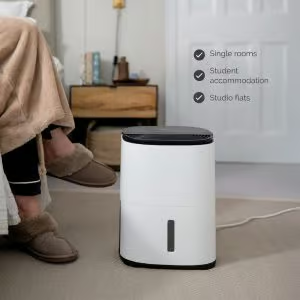
If you need a dehumidifier for drying clothes in student accommodation, our MeacoDry Arete®s are ideal – especially the Arete® One 6L Dehumidifier / Air Purifier. Compact in size, it’s the perfect choice for student rooms and will dry a whole load of clothes in just six hours with Smart Laundry Mode. This is a big win when considering how long laundry can take to dry, especially if your room is often cold!
Worried about running costs?
Don’t be.
Our Arete® One 6L Dehumidifier / Air Purifier is designed for maximum energy efficiency, costing a very student-friendly 3p per hour based on a running cost of 26.32p/kWh.
The Arete® even doubles up as an air purifier which filters out mould spores and other indoor air pollutants for a fresher, cleaner environment.
With its compact size, Smart Laundry Mode, energy efficiency and 2-in-1 design, the Arete® One 6L is certainly one of the best dehumidifiers for drying clothes in a student room.
Once you’ve started following these tips when drying your clothes, you’ll soon see a big difference. So you can forget about your laundry and enjoy having more time for studying and socialising – just the way it should be.
FAQs
Yes, you can dry clothes in a student room but you need to be mindful of causing problems such as mould and damp as a result of high humidity. These problems can be tackled with good ventilation or a dehumidifier.
Yes, drying clothes indoors can cause damp if the excess moisture in the air is not removed by either ventilating the room or using a dehumidifier.
If your housemates are drying clothes exclusively on radiators, all that moisture from those wet hockey socks and jumpers is released into the room. Without adequate ventilation or dehumidification, this can lead to higher humidity, condensation and, over time, potentially mould and damp.
You can dry clothes in your bedroom or any other room, as long as it has either good ventilation or a dehumidifier to manage the relative humidity. If humidity is too high, you will experience problems like mould and damp.
If the moisture evaporating off your clothes isn’t removed via an open window, vent or a dehumidifier, condensation will form. This happens because when moisture in the air meets a surface that’s colder than the air in the room, it condenses. Traditionally, this is when we see overnight air temperatures below 5C. In the UK, that’s really common from late October and even into early March.
While condensation can form on both single and double glazing, the problem is worse on single-glazed windows because they are colder than the interior glass on double-glazed windows.
Read more on condensation – is it as simple as opening a window?
Featured Products
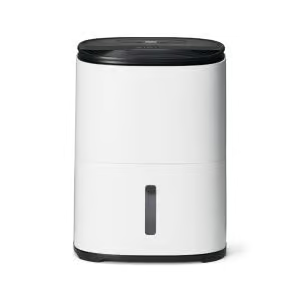
Arete® One 6L Compact Dehumidifier / Air Purifier
Available in Warm Pebble and Charcoal
- Prevent damp, mould and condensation
- 2-in-1 dehumidifier and air purifier for year-round air treatment
- Dry clothes in 6 hours with Smart Laundry Mode
- Low running costs of just 3p*/hour
- Compact and lightweight, easy to store away
*based on 26.32p / kWh